How to See the Northern Lights in Murmansk, Russia: A First-Timer's Guide
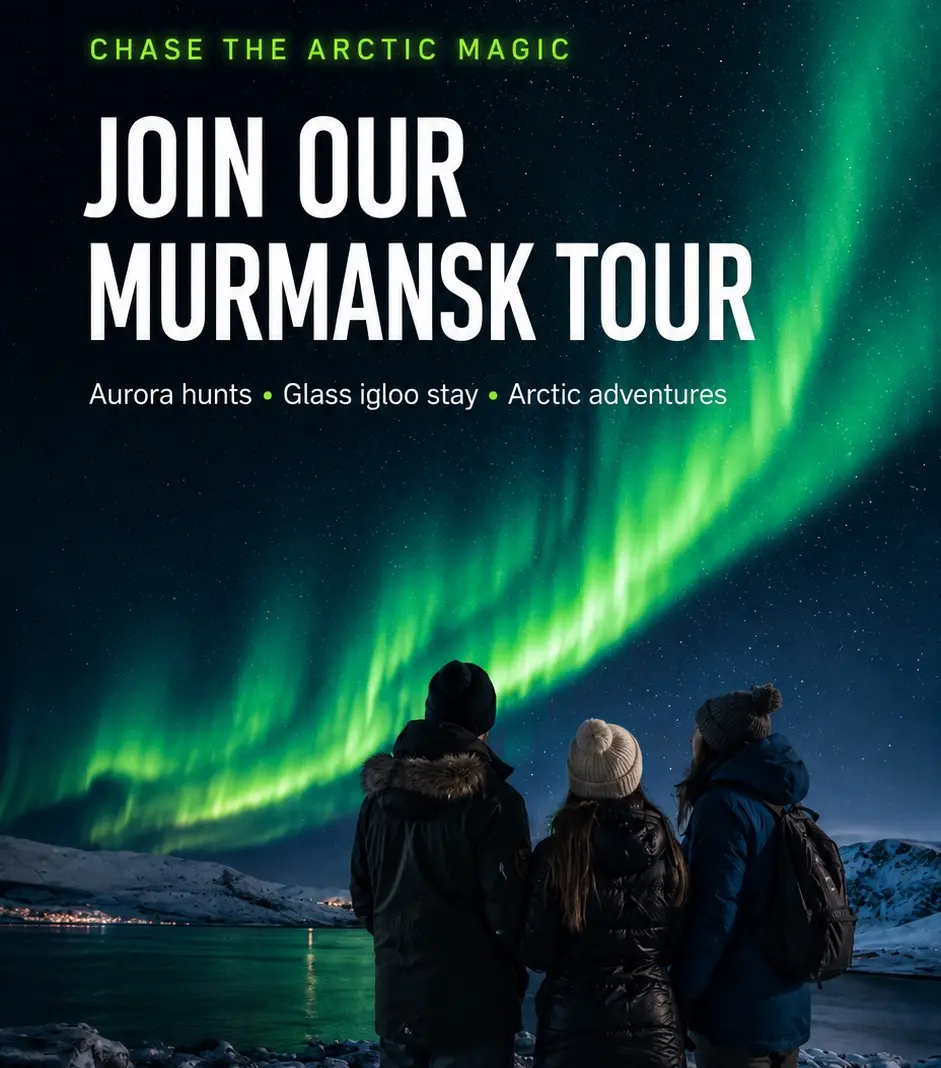
So you've decided you want to see the Northern Lights in Murmansk. Now comes the bigger question:
How do you actually go about seeing them?
Aurora hunting isn't like booking a sightseeing tour with a fixed start time and guaranteed view. You need sufficiently dark skies, favourable geomagnetic activity, clear enough weather and the right location. Some nights you may see the lights quickly. Other nights can involve waiting, checking forecasts and driving away from cloud cover or city lights.
After running Northern Lights trips to Murmansk, one thing we tell first-time travellers is simple:
Don't plan your entire trip around one night.
Give yourself several days in the Arctic, stay flexible and treat the Northern Lights as something you hunt, rather than something you simply turn up to see.
Here's exactly how to plan it.
Why Choose Murmansk for Your First Northern Lights Trip?
For Indian travellers planning their first Aurora trip, Murmansk has one big advantage: you can build an entire Arctic holiday around the Northern Lights rather than travelling only for one night of sky-watching.
Murmansk is located above the Arctic Circle and is connected to Moscow and St Petersburg by domestic flights, making it relatively straightforward to combine with a larger Russia itinerary. Your existing guides also highlight the combination of Aurora hunting with Arctic experiences such as reindeer and husky encounters, glass-igloo stays and trips into the wider Murmansk region.
For us, that matters.
Because the Northern Lights can never be guaranteed, we'd much rather travel somewhere where the trip is still worth taking even before the Aurora appears.
That's exactly how we approach Murmansk: spend several days in the Arctic, experience the landscape and winter activities during the day, and keep the evenings flexible for Aurora hunting.
See our Murmansk Northern Lights Tour from India.
Our own relationship with Murmansk goes back years. One of the things we still remember from our early Arctic trips is flying into a runway covered in snow and stepping out into an entirely white landscape. For travellers coming from India, simply arriving in Murmansk can feel like part of the experience before the first Aurora hunt has even begun.
And that's also why we don't treat Murmansk as somewhere you visit for one evening. Over the years, our trips have combined Aurora hunting with the wider Arctic experience — snow-covered landscapes, huskies, reindeer and unique Arctic stays — while keeping several days in the region rather than putting everything on one night.
How to See the Northern Lights in Murmansk: 5 Things That Matter
If seeing the Aurora is one of the main reasons you're travelling to Murmansk, focus on these five things.
1. Travel During the Dark Season
You need darkness to see the Northern Lights.
For most travellers, the practical Murmansk Northern Lights season runs through the darker months from autumn into early spring. Exactly which month you choose should depend on whether you want deep snow, comparatively milder temperatures, polar night or more daylight for other Arctic experiences.
We've covered that separately rather than repeating the entire month-by-month guide here.
Best Time to See Northern Lights in Murmansk
2. Give Yourself More Than One Night
This is probably the most important advice in this entire guide.
If you fly into Murmansk, attempt one Aurora hunt and leave the next morning, your entire experience depends on the conditions of one evening.
Clouds could move in.
Conditions could improve the next night.
Geomagnetic activity can change.
That's why our own current Northern Lights itineraries keep travellers in Murmansk for around five days rather than treating it as a one-night stop. Our organised Aurora hunts can last four to five hours, with the actual evening kept flexible depending on conditions.
Multiple nights still don't guarantee the Northern Lights.
They simply give nature more than one opportunity to cooperate.
3. Don't Depend Only on the City Centre
Can you see the Northern Lights from Murmansk city?
Sometimes, yes—particularly during a stronger display.
But that doesn't mean the middle of the city is where you should plan your Aurora hunt.
NOAA recommends getting away from city lights when viewing the Aurora, because darker skies make faint displays easier to see.
That's why proper Aurora hunting in Murmansk often involves driving away from brighter areas rather than standing outside your hotel and waiting.
And importantly, don't become obsessed with finding one famous “Northern Lights viewpoint.”
The best place tonight may not be the best place tomorrow.
Why?
Because cloud cover moves.
Your actual viewing location should depend on the conditions that evening.
4. Check Both the Aurora Forecast AND the Weather
This is where many first-time Aurora hunters go wrong.
They check the Kp index.
They see a high number.
They get excited.
But there could be thick clouds above Murmansk.
And an active Aurora happening above a completely clouded sky is still an Aurora you can't see.
The Kp index, which ranges from 0 to 9, is one measure of geomagnetic activity. Higher geomagnetic activity can produce brighter or more widespread Aurora displays—but NOAA also points out that if you're already in the right northern location, beautiful Aurora displays can be visible even at relatively modest Kp levels.
So don't use Kp as your only decision-maker.
You need to consider:
Aurora activity + cloud cover + darkness + location.
We've explained the forecasts in much more detail here:
Murmansk Northern Lights Forecast: How to Read the Aurora Prediction
5. Keep Your Aurora Hunt Flexible
This is why we don't like treating Aurora hunting like a rigid sightseeing slot.
On our Murmansk trips, the first Northern Lights hunt can happen on different nights depending on conditions.
That's the advantage of spending several days in the region.
If tonight isn't looking promising, you haven't necessarily lost your only opportunity.
And that is also where travelling with people who understand the local conditions can make a huge difference.
Where to See the Northern Lights in Murmansk
One of the most searched questions is:
“Where is the best place to see the Northern Lights in Murmansk?”
The answer is slightly frustrating:
There isn't one permanent best spot.
A darker area outside the brightest parts of the city will usually give you a better viewing environment, but the best direction on a particular night can depend on cloud conditions and the forecast. NOAA similarly recommends darkness and avoiding city lights for better Aurora viewing.
That means a proper Aurora hunt may involve driving rather than staying in one predetermined location.
Some experiences you can consider include:
Outside Murmansk City
This is the simplest option for most travellers.
You can stay in Murmansk for convenience and head away from the brighter city areas during the hunt.
Remote Arctic Stays and Glass Igloos
A remote stay gives you another potential viewing opportunity without needing to leave your accommodation.
Our Northern Lights itineraries have included a glass-igloo stay, which gives travellers another chance to watch the sky from a darker Arctic location.
Just remember:
A glass igloo doesn't guarantee the Northern Lights either.
It simply gives you a pretty spectacular place to be if they do appear.
Teriberka
Teriberka is a remote village on the Barents Sea in the Murmansk region and can be combined with a wider Arctic trip.
But don't build your entire Aurora strategy around Teriberka.
Winter access can be affected by road conditions; even Your Travel Genie's itineraries keep a Teriberka visit conditional depending on whether the road is open.
How to Plan a Teriberka Trip from India
What Actually Happens on an Aurora Hunt in Murmansk?
If this is your first Northern Lights hunt in Murmansk, you might imagine getting out of a vehicle, looking up and immediately seeing a sky filled with green.
Reality can be very different.
A hunt may last several hours.
On our trips, the organised hunt can run for approximately four to five hours, and the guide monitors the conditions while travellers move between locations or wait for the sky to change. Our current tours also use an Aurora guide who is a photographer so guests can get proper photographs if the lights appear.
There can be a lot of waiting.
You might spend time inside a heated vehicle.
You might head outside, realise conditions aren't right and move again.
You might be staring at what looks like an empty sky for a while.
And that's completely normal.
The word “hunting” is pretty accurate.
Do You Need a Guide for Aurora Hunting in Murmansk?
Technically, you can attempt to see the Northern Lights independently.
But for a first-time Murmansk Northern Lights trip, we prefer a guided hunt.
Not because a guide can magically make an Aurora appear.
They can't.
A good guide's value is knowing how to interpret the conditions, deciding where to go, navigating outside the city at night and adapting when weather conditions change.
This becomes particularly useful during an Arctic winter, when you're dealing with unfamiliar roads, snow, very low temperatures and potentially remote viewing locations.
If you're experienced with Arctic driving and know how to interpret weather and Aurora forecasts, independent hunting is possible.
For a first visit?
We'd rather focus on looking at the sky than figuring out where we're driving at midnight.
How Many Nights Should You Stay in Murmansk for Northern Lights?
If the Northern Lights are a major reason for your trip, we'd recommend building at least four to five days in the Murmansk region into the overall itinerary rather than flying in for a single night.
That's also how we currently structure our own trips: around five days in Murmansk, leaving enough time for Aurora hunting alongside other Arctic experiences.
The logic is simple.
One night = one set of conditions.
Several nights = several opportunities.
That doesn't translate into a guaranteed percentage chance, and we'd be wary of anyone promising one.
But if you've flown all the way from India to the Arctic specifically hoping to see the Northern Lights, giving yourself multiple evenings makes far more sense than gambling everything on one.
What Conditions Do You Need to See the Northern Lights?
You don't need to become a space-weather expert before travelling to Murmansk.
But understanding four basics helps.
Darkness: The Aurora needs a sufficiently dark sky to be visible.
Clear skies: Cloud cover can hide the Aurora even if it is active overhead.
Geomagnetic activity: Increased activity can produce brighter and more widespread displays.
Location: Darker surroundings away from excessive artificial light generally provide better viewing conditions.
NOAA also notes that Aurora activity is commonly strongest around the hours near local midnight, with roughly 10 PM to 2 AM often being a productive viewing window—but that doesn't mean the lights operate on a timetable. Displays can appear earlier or later depending on conditions.
That's why flexibility matters more than setting an alarm for exactly 11 PM.
What First-Time Aurora Hunters Usually Don't Expect
We've written an entire article about the difference between Northern Lights expectations and reality, because this surprises almost everyone on their first trip.
A few things are worth knowing before you go.
The Aurora May Look Different to Your Camera
Modern phones and cameras can capture colour differently from the naked eye, particularly during fainter displays.
Don't spend your entire sighting looking at a screen.
Take the photograph.
Then put the phone down and look up.
You May Need to Wait
Seeing photographs of enormous green skies makes it easy to imagine that the lights are permanently dancing above Murmansk every winter night.
They aren't.
Aurora hunting involves patience.
It Gets Much Colder When You're Standing Still
Walking around Murmansk during the day and standing outside waiting for the Aurora at midnight are two completely different experiences.
Dress for the latter.
We have a dedicated guide explaining exactly what layers, footwear and winter accessories to carry rather than repeating the entire packing list here.
Northern Lights Packing Guide for Russia
Seeing the Lights Shouldn't Be the Only Thing That Makes Your Trip Worthwhile
This is something we've learned after operating these trips.
Build a Murmansk itinerary you'd enjoy even before the Aurora appears.
Snow-covered Arctic landscapes, Teriberka when accessible, Sámi experiences, reindeer, huskies, glass igloos and simply being above the Arctic Circle are part of the journey.
Then if that green streak finally appears overhead?
That's the bonus everyone remembers.
What It's Like to Witness the Northern Lights in Russia: Expectations vs Reality
How to Get to Murmansk From India
Most Indian travellers combine Murmansk with a wider Russia itinerary.
Our current trips route travellers India → Moscow → Murmansk, with an internal flight taking the group north into the Arctic region.
You can absolutely plan Murmansk independently, but Arctic travel adds additional logistics compared with visiting Moscow or St Petersburg—particularly winter transport, remote accommodation, local transfers and weather-dependent plans.
If you're travelling independently, give yourself some buffer rather than constructing an itinerary where every connection and activity depends on everything running perfectly.
And check Russia's current entry and visa requirements separately before booking, because those rules can change.
Our Biggest Advice After Running Northern Lights Trips to Murmansk
If we had to reduce this entire guide to three pieces of advice, they would be:
Don't travel for one Aurora night.
Don't expect an app to predict exactly what you'll see.
Don't make the Northern Lights the only reason you'll enjoy Murmansk.
We've had travellers wait in the cold, drive into the Arctic darkness and wonder whether tonight will be the night.
That's the frustrating part.
It's also what makes the moment so special when somebody finally looks up and says:
“There. Look!”
You don't know exactly when it's coming.
And that's the magic of it.
FAQs: Seeing the Northern Lights in Murmansk
Where is the best place to see Northern Lights in Murmansk?
There isn't one permanent best location. Darker areas away from brighter city lights are generally preferable, but the best direction on a particular night can depend on weather and cloud cover. A guided Aurora hunt can move according to the conditions rather than relying on one fixed viewpoint.
Can you see the Northern Lights from Murmansk city?
Yes, they can sometimes be visible from the city, particularly during stronger displays. However, getting away from artificial light usually creates better viewing conditions, which is why most dedicated Aurora hunts travel outside brighter urban areas.
How many nights should I spend in Murmansk?
If seeing the Northern Lights is a major goal, we prefer several nights rather than one. Our own itineraries currently spend about five days in Murmansk, giving travellers multiple opportunities around the wider Arctic experience.
Do I need a guide for Northern Lights hunting in Murmansk?
It isn't compulsory, but we would recommend one for most first-time visitors. Local guides can monitor conditions, choose viewing areas and handle the driving and logistics while you concentrate on the experience.
What is the best time to see the Northern Lights in Murmansk?
The darker months from autumn into early spring make up the main viewing season. The ideal month depends on whether you prioritise snow, weather, daylight or winter activities, so we've covered that separately in our Best Time to See Northern Lights in Murmansk guide.
Are the Northern Lights guaranteed in Murmansk?
No.
The Aurora is a natural phenomenon. No responsible guide or tour company should guarantee a sighting.
What you can do is travel during the right season, stay for several nights, follow weather and space-weather conditions and remain flexible about where and when you hunt.
Ready to Go Aurora Hunting in Murmansk?
We've been taking Indian travellers into Arctic Russia for years, and our biggest priority is giving the Northern Lights more than one opportunity to show up.
Our Murmansk trips spend several days in the Arctic and combine a guided Northern Lights hunt with a photographer, a glass-igloo experience and other carefully planned Arctic activities.
VIEW OUR MURMANSK NORTHERN LIGHTS TRIP
No comments yet. Be the first to start the conversation!